
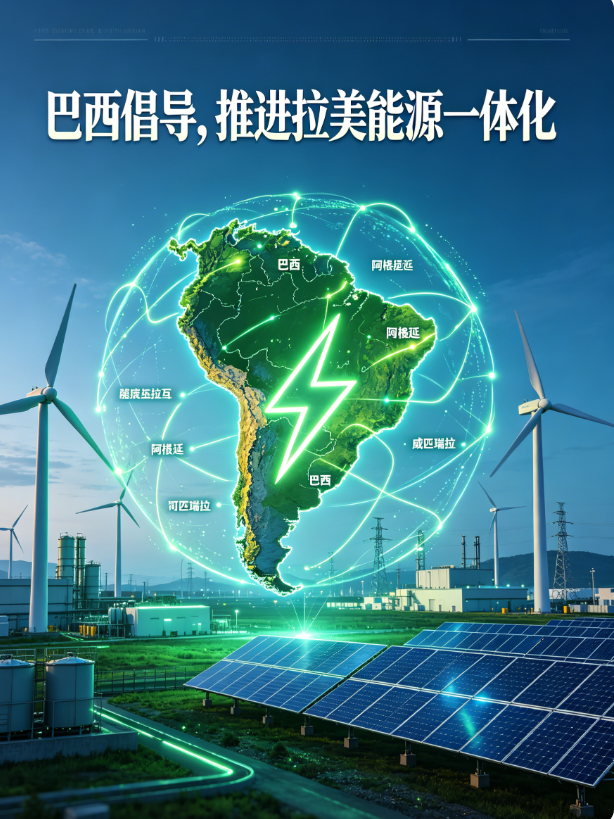
Latin American Energy Integration: Brazil's Gradual Approach and Sovereignty Balance
Keywords
Latin American energy integration; Brazil; regional power interconnection; sovereignty and energy security; renewable energy; gradual integration
Introduction
Against the backdrop of global energy transition and geopolitical competition, regional energy cooperation is becoming an important path for developing countries to enhance energy security and optimize resource allocation. The convening of the 8th Energy Ministers Meeting of the Community of Latin American and Caribbean States (CELAC) provides a key platform for regional countries to review the energy integration process. As the largest economy in South America, Brazil clearly expressed its support for regional energy integration at the meeting while emphasizing the bottom line of respecting national sovereignty and energy security. This stance reflects both the practical needs of energy cooperation in Latin America and the core contradiction that must be faced in the integration process—how to strike a balance between sovereignty concessions and collective benefits. This article will analyze the opportunities, challenges, and feasible paths of Latin American energy integration from Brazil's perspective.
I. Regional Power Interconnection: Cost Reduction, Efficiency Improvement, and Security Resilience
Guilherme Zanetti, Director of the Department of Power Transmission, Distribution and International Interconnection at the Brazilian Ministry of Mines and Energy, pointed out at the meeting that strengthening regional power interconnection can help improve the operational efficiency of energy systems, reduce energy costs, and enhance energy supply security. This judgment is highly consistent with the development trend of the global energy landscape. As the share of renewable energy in countries' energy structures continues to rise, the volatility and intermittency of power systems are becoming increasingly prominent. The construction of cross-border power interconnection networks can effectively smooth supply and demand fluctuations through geographical complementarity of wind and solar and hydropower regulation, reducing dependence on fossil fuel backup capacity.
Latin America is rich in hydro, solar, and wind resources, but resource endowments vary significantly among countries. Brazil has the world's second-largest hydropower installed capacity; Argentina and Chile have great potential in wind and solar; while Central American countries face unstable power supply. Through regional power interconnection, Brazil's hydropower can be transmitted to neighboring countries during wet seasons, and during dry seasons, it can import wind and solar power from Argentina or Chile, achieving cross-seasonal and cross-regional optimal resource allocation. According to the “Indicative Plan for Regional Power Interconnection 2040” prepared by the Latin American Energy Organization (Olade), the 16 priority projects to be implemented by 2040 have a total investment of about US$3.5 billion and can add about 5,000 MW of regional interconnection capacity. Although this scale is only equivalent to the installed capacity of a medium-sized hydro plant, its strategic significance lies in connecting national power markets through the “capillaries” of infrastructure, laying the physical foundation for deeper energy cooperation.
II. Sovereignty and Security: The Insurmountable Bottom Line in Integration
Despite Brazil's positive attitude toward regional power interconnection, Zanetti clearly stated that regional energy cooperation should be based on respect for national sovereignty and the guarantee of energy security. Countries should retain the right to independently formulate energy policies and ensure their own energy supply; energy integration should not weaken national decision-making autonomy. This stance has profound practical considerations.
In Latin America's history, many regional integration projects have been shelved due to sovereignty disputes or political changes. For example, the South American energy integration initiative promoted by the Union of South American Nations (UNASUR) made slow progress due to differences in national energy policies, rising resource nationalism, and geopolitical competition. As a regional power, Brazil knows well that pushing integration without common political will and institutional guarantees could lead to negative consequences such as energy supply interruption and rising investment risks. Therefore, Brazil's advocated “gradual” path is essentially a pragmatic strategy—first accumulating cooperation experience through technical interconnection, then gradually exploring rule coordination, rather than establishing a supranational energy market regulatory framework in one step.
Energy security involves even more complex dimensions. For countries dependent on oil and gas exports like Venezuela and Ecuador, energy integration may mean a weakening of resource control; for a country like Brazil with a high proportion of hydropower, cross-border electricity trade may affect its domestic pricing mechanism and power supply priority. Therefore, Brazil's emphasis that countries should guarantee their own energy supply right essentially sets a “security valve” for integration—when domestic supply and demand are tight, countries have the right to prioritize their own needs rather than unconditionally fulfilling cross-border power supply obligations.
III. Flexible Gradualism: A Feasible Path from Technical Interconnection to Market Integration
During the meeting, Brazil proposed specific cooperation directions: as renewable energy installed capacity continues to grow, cross-border transmission network construction and regional power market coordination are expected to become important directions for future energy cooperation in Latin America; regulatory coordination and rule alignment should be strengthened to promote energy cooperation, while avoiding forced unified regulatory frameworks, and advancing regional energy market integration in a flexible and gradual manner.
This approach reflects a deep understanding of Latin America's actual conditions. Currently, the power market structures of Latin American countries vary greatly: Brazil has a highly marketized electricity trading system, Argentina adopts a government-led pricing model, and Central American countries mostly rely on state-owned enterprises. Forcing a unified regulatory framework not only faces political resistance but may also cause market distortions due to inappropriate institutional transplantation. A more feasible path is to advance in stages: the first stage focuses on building cross-border transmission lines and achieving preliminary interconnection through bilateral or multilateral power purchase agreements; the second stage establishes a regional power dispatch center and trading platform, allowing countries to conduct surplus-deficit adjustments while retaining their own market rules; the third stage gradually coordinates technical standards, environmental requirements, and ancillary service pricing mechanisms, creating conditions for a final unified regional market.
Taking existing interconnection projects between Brazil and Uruguay and Argentina as references, these successful cases all followed the principle of “pilot first, gradual expansion.” For example, a 500 kV double-circuit transmission line between Brazil and Uruguay was built as early as 1999, but it still operates under bilateral agreements and has not been incorporated into a unified South American power market framework. This gradual path effectively avoids the risk of cooperation breakdown due to excessive haste.
IV. Renewable Energy and Digital Transformation: New Growth Poles for Future Cooperation
Latin America has huge potential for renewable energy development. According to IRENA data, Latin America's renewable energy installed capacity accounted for about 8% of the global total in 2022, with Brazil, Mexico, Chile, and Argentina as main contributors. As countries set carbon neutrality goals, renewable energy installations will experience explosive growth in the next decade. In this context, the digitalization and smartification of power systems become key infrastructure supporting regional interconnection. The application of technologies such as smart grids, demand response, and energy storage can significantly improve the efficiency and reliability of cross-border electricity trading, reducing dependence on traditional peaking units.
As a regional technological innovator, Brazil has accumulated rich experience in smart meter deployment and ultra-high voltage transmission. By exporting technical standards and management experience to neighboring countries, Brazil can not only promote regional energy integration but also strengthen its voice in Latin American energy governance. In addition, the alignment of regional carbon markets is a potential cooperation direction. Brazil has huge forest carbon sinks and clean power resources; if it can monetize low-carbon value through cross-border electricity trade, it will inject new economic impetus into regional energy cooperation.
Conclusion
Latin American energy integration is a long-term and complex systemic project that requires balancing multiple relationships: efficiency and fairness, openness and security, collective action and national sovereignty. Brazil's stance at the 8th CELAC Energy Ministers Meeting—supporting integration while insisting on gradual progress and sovereignty priority—provides a pragmatic and feasible reference framework for regional cooperation. By strengthening infrastructure construction, promoting regulatory coordination rather than unification, and focusing on technical standard compatibility rather than institutional homogenization, Latin American countries can gradually build a regional energy community that shares benefits and risks while respecting each country's conditions. This will not only enhance the region's energy security and sustainable development but also provide important experience for Global South countries in exploring new models of regional governance. In the future, with the advancement of renewable energy technology and the acceleration of digital transformation, Latin American energy integration is expected to move from vision to reality, becoming a model of South-South cooperation.

