
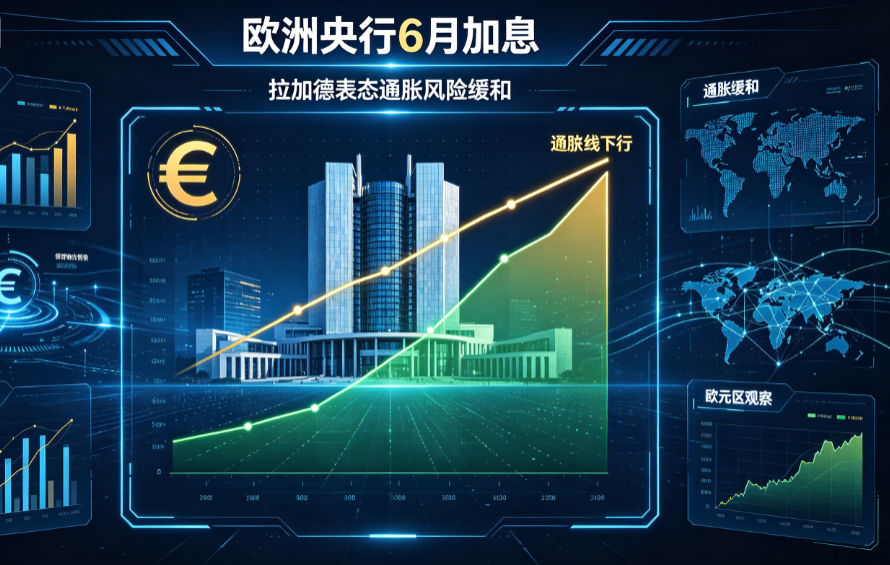
ECB Policy Shift Ahead? Lagarde Confirms June Rate Hike, New Trade-offs Amid Moderating Inflation Risks
Keywords
ECB, Lagarde, Rate Hike, Inflation, Oil Prices, Geopolitical Situation, Rate Decision
Introduction
Amid the wave of continued monetary tightening by major central banks globally, every move by the ECB grips market nerves. Recently, ECB President Lagarde publicly stated that the June 25 bps rate hike was "correct," but also emphasized that upside inflation risks have moderated. This statement has triggered a reassessment of the ECB's future policy path by financial markets. The market generally expects that the upcoming July monetary policy meeting may keep borrowing costs unchanged, with subsequent decisions highly dependent on oil price fluctuations and the evolution of the geopolitical situation. Caught between inflationary pressures and slowing economic growth, the ECB stands at a delicate policy crossroads. This article delves into the ECB's current policy logic, changes in the inflation outlook, and key variables for future decisions, starting from Lagarde's remarks.
I. June Rate Hike: Economic Logic Behind the Correct Decision
Lagarde confirmed the June rate hike as "correct," a statement that is not merely self-defense but based on a prudent assessment of the eurozone economic situation. In June this year, against a backdrop of still-high inflation, the ECB raised all three key rates by 25 bps, bringing the main refinancing rate to 4.00%, the deposit facility rate to 3.50%, and the marginal lending rate to 4.25%. Although this pace was slower than several previous 50 bps hikes, its symbolic significance cannot be ignored — it marked the eighth consecutive rate hike since the ECB started its tightening cycle in July 2022.
From a data perspective, eurozone HICP inflation in May stood at 6.1% year-on-year, down from its peak but still far above the ECB's 2% target. Core inflation (excluding energy and food) was 5.3%, showing sticky price pressures. Lagarde believed that with inflation not yet clearly turning a corner, continued rate hikes were necessary to contain a price spiral. Additionally, the eurozone economy barely avoided a recession in Q1 2023, with GDP growth flat quarter-on-quarter, but the labor market remained tight, with unemployment at historic lows, providing fundamental support for the rate hike.
However, Lagarde also noted that the June hike was not the end but the optimal choice based on information available at the time. She emphasized that policymakers must continuously adjust their stance based on incoming data. This implies that the ECB is not locked into a path of continuous rate hikes but retains flexibility for future decisions.
II. Upside Inflation Risks Moderate: Data Trends and Deep Causes
The most notable change in Lagarde's rhetoric is her acknowledgment that "upside inflation risks have moderated." This marks a substantive shift in the ECB's assessment of the inflation outlook. Over the past year, the ECB repeatedly stressed that inflation risks were tilted to the upside, leading to aggressive rate hikes. Now, the wind seems to be changing.
The moderation of inflation risks stems from multiple factors. First, the sharp decline in energy prices is the main driver. Brent crude has fallen from over $120/bbl in June 2022 to around $75/bbl, a drop of more than 35%. Natural gas prices have also fallen sharply from historical highs, with the European benchmark TTF gas futures dropping from over EUR 300/MWh in August 2022 to around EUR 30/MWh. Lower energy costs have directly transmitted to producer prices, thereby easing consumer price pressures.
Second, the gradual repair of supply chain bottlenecks has also played a key role. With the normalization of post-pandemic economic activity and the recovery of shipping capacity, transportation costs have fallen significantly, and component shortages have eased. The supplier delivery times index in the eurozone manufacturing PMI has returned to normal range from extreme stress, helping to reduce industrial goods prices.
Third, the ECB's own tightening is taking effect. The lagged impact of rate hikes is becoming apparent, with tighter credit conditions curbing investment and consumption. Loan growth to eurozone businesses and households has slowed markedly, and the growth rate of money supply M3 is also declining. These indicators show that the monetary policy transmission mechanism is working, weakening demand-side pressures in the economy.
Nevertheless, Lagarde warned that the path of disinflation will not be smooth. Core services inflation remains sticky, and accelerating wage growth could pose new upside risks. Ongoing labor negotiations in major economies like Germany and minimum wage increases could push up service prices. Additionally, fiscal stimulus measures (such as the phase-out of energy subsidies) may cause one-off price shocks in the short term. Therefore, while acknowledging the moderation of risks, the ECB has not declared victory but emphasizes the need for more data to confirm the trend.
III. July Meeting: Probability of Holding Rates Unchanged Rises
Based on the assessment of moderating inflation risks, market expectations for the ECB's July meeting have changed markedly. Rate futures pricing shows that the probability of holding rates unchanged in July has risen from about 30% a month ago to over 60%. Most analysts believe the ECB will pause rate hikes at this meeting to observe the cumulative effects of previous tightening.
The logic supporting this expectation is that the eurozone economy has shown signs of weakness. The composite PMI in June fell to 50.3, near stagnation level, while the manufacturing PMI fell to a distressed level of 43.6. Industrial output has declined for several months, and the German economy has fallen into recession (Q1 GDP down 0.3% quarter-on-quarter). In this context, further rate hikes could exacerbate downside risks to the economy, even triggering a hard landing.
Additionally, the hawk-dove divide within the ECB is widening. While hawkish members advocate further rate hikes to eradicate inflation completely, dovish members worry about irreversible damage from over-tightening. As President, Lagarde needs to build consensus. Her proactive mention of moderating inflation risks likely paves the way for a pause, aiming to manage market expectations and avoid unnecessary volatility.
However, holding rates unchanged does not mean an immediate shift to easy policy. The ECB will likely emphasize in the July meeting that "keeping rates sufficiently high for long enough" remains the core strategy. In other words, even if it pauses rate hikes, rates will stay at current high levels until inflation clearly returns to target. Such a "higher for longer" forward guidance will be key content of the July statement.
IV. Key Variables for Future Decisions: Oil Price Volatility and Geopolitical Evolution
Lagarde explicitly stated that the ECB's future decisions will be "highly dependent on oil price volatility and the evolution of the geopolitical situation." This is not empty talk but points to the crux of the eurozone economy. As a net energy importing region, the eurozone is extremely sensitive to global energy prices. Every $10/bbl increase in oil prices raises eurozone headline inflation by about 0.3 to 0.5 percentage point, with a lagged transmission process.
Current oil prices face multiple uncertainties. OPEC+ continues to cut production, with Saudi Arabia voluntarily cutting an additional 1 million bpd, tightening global oil supply. Meanwhile, releases from the U.S. Strategic Petroleum Reserve are nearing completion, while shale oil production growth is slow. On the demand side, the strength of China's economic recovery is uncertain, and the European slowdown may also curb oil demand. This two-sided uncertainty makes oil price trends extremely hard to predict.
Geopolitical tensions are a lingering shadow over the ECB. The Russia-Ukraine conflict has lasted over a year; although the front line is mired in stalemate, the risk of escalation always exists. If the situation worsens, it could again trigger a gas supply disruption and energy price spike. Additionally, the Middle East situation is far from optimistic; Iran nuclear talks are at an impasse, and the Israel-Palestine conflict could spill over, all of which could roil global energy markets.
Beyond energy, geopolitics also affects inflation through trade channels. De-risking of global supply chains and nearshoring trends are raising production costs, offsetting some of the price dividends from globalization. When assessing the inflation outlook, the ECB must incorporate these structural factors into its models. Lagarde's remarks reflect a sober awareness of this complexity.
V. Conclusion: Seeking Balance Between Inflation and Growth
In summary, Lagarde confirmed the June rate hike as correct while noting moderating inflation risks, showing the ECB's delicate balance in policy communication. The July meeting is likely to keep rates unchanged, but this is a tactical pause, not a strategic shift. Every future step by the ECB will be like walking a tightrope — preventing inflation from reigniting while avoiding overburdening the economy.
For markets, the short-term direction of the euro will depend on oil prices and geopolitical shocks. If energy prices stay stable and geopolitical conditions do not deteriorate sharply, the euro may get a respite and risk asset sentiment may improve. Conversely, if a black swan event erupts, the ECB may be forced to respond with emergency measures, even considering rate cuts. However, the probability of such extreme scenarios remains low for now.
Looking ahead to the second half of the year, the challenges facing the European economy remain severe. High interest rates will continue to restrain demand, and the withdrawal of fiscal policy may also drag on growth. But if inflation falls as expected, rising real rates will automatically tighten financial conditions, leaving room for future rate cuts. Lagarde's remarks remind us that policymakers are not omniscient; they can only rely on constantly changing data to make suboptimal choices. What investors need to do is understand this uncertainty and adjust asset allocation accordingly.
The ECB's policy ship is entering uncharted waters. The crew's data compass may instantly change course due to a gust of wind (oil price surge) or an undercurrent (geopolitical shock). Lagarde's "correct decision" and "risk moderation" are merely a searchlight along the voyage, illuminating a stretch ahead but not guaranteeing the safety of the entire journey. Market participants must remain vigilant to steady their own helm amid the storm.

